Why hops is a powerful herb for sleep, stress and digestion
Hops entered my life long before I knew it as medicine. I grew up in a small Flemish town where the brewery was important enough for every child to visit as part of the school curriculum. Beer wasn’t presented as artisan or unusual. It was simply there, woven into the place and the working lives of the people around us.
My grandfather, my father’s father, was a foreman at the brewery. He was tall, heavily built and rather stubborn, and he didn’t really do much emotion. My father was the exception in that family. He felt everything and often showed it, sometimes more than he knew what to do with. I understand that about him much better now than I did when he was alive.
For years, hops belonged to that childhood world of breweries and beer. I knew the smell before I knew the plant, and I certainly didn’t imagine that I would one day grow it in a tiny English garden and teach people how to use it as medicine.
The plant behind the beer
The hop in my garden disappears completely each winter. The long bines die back and for a while it is difficult to believe they could ever have covered a fence. Then the first shoots push through in spring and it begins again, wrapping itself around anything it can reach and travelling far further than I ever intended.
Technically, hops is a bine rather than a vine. It climbs by winding its stem around a support, helped by tiny stiff hairs that catch against whatever is nearby. It is a perennial, rooted below ground even when nothing remains visible above it.
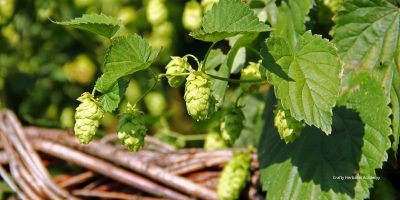
Hops (Humulus lupulus) belongs to the Cannabaceae family, alongside cannabis, and there is something in the resinous scent that makes the relationship understandable. The plants are either male or female, and it is the female plant that produces the familiar papery cones used in brewing and medicine. Pull a ripe cone apart and you will find a yellow, sticky powder around the base of the scales. This is lupulin, produced by the resin glands of the plant. It contains the bitter acids, volatile oils and other constituents responsible for much of the flavour, scent and medicinal activity of hops.
Hops didn’t always have such complete ownership of beer. Earlier European brewers used mixtures of herbs known as gruit, which varied from place to place and might include plants such as bog myrtle, yarrow and mugwort. Hops gradually took over because its bitterness balanced the sweetness of the malt and helped preserve the beer. It was a practical choice that eventually changed the taste of brewing.
The medicine inside the bitterness
If you have only met hops through beer, make a cup of hop tea. You won’t mistake it for anything else. The bitterness arrives immediately and stays in the mouth, while the smell is green, resinous and slightly heavy. It is not a gentle bedtime tea, and most people won’t want a second cup.
That bitterness is part of the medicine. We begin responding to bitter tastes before the herb has even reached the stomach: saliva increases, the digestive system wakes up and the body prepares itself for food. I think of hops when appetite and digestion have become sluggish, especially when nervous tension is sitting across the stomach and making it difficult for somebody to properly take food in.
In practice, though, I use hops mainly as a nervine sedative. I don’t begin with “insomnia equals hops”, because sleeplessness can arise from so many different states. I want to know what is keeping the person awake. Are they worried, overstimulated, physically restless, too hot, in pain, waking with a rush of adrenaline, or simply so exhausted that their nervous system can no longer settle?
I reach for hops particularly where tiredness and tension present together. The person is longing to sleep, but their body is still braced and their mind is going back over the day. There may be irritability, muscular tension and a feeling of pressure that hasn’t found anywhere to go. Sometimes the same tension is felt in the digestion, with a clenched stomach, poor appetite or discomfort that worsens during stressful periods.
It is quite a strong presence in a formula, even in modest amounts, so I think carefully about what else belongs in the blend. Hops may be combined with other nervines according to the person: skullcap where the mind is looping and overstimulated, passionflower where thoughts won’t loosen their grip, or valerian where sleeplessness is accompanied by muscular tension and spasm. The blend needs to fit the whole picture rather than simply contain several herbs associated with sleep.
Hops is a very useful medicinal plant, but it is not a general-purpose answer to insomnia. Its bitterness, heaviness and cooling nature are exactly what make it right for some people and quite wrong for others.
Who does hops suit?
In energetic terms, hops is cold, bitter and drying. I’m careful with it in somebody who is already cold, depleted and low in mood, because too much may pull them down further. It is much better suited to heat and tension: the person whose thoughts won’t stop, whose jaw remains tight and whose irritability rises as tiredness deepens. I also think of it when sleeplessness accompanies hot flushes and night heat, although the hormonal aspect of the plant needs a little more explanation.
I don’t want to reduce the plant to its known chemical constituents alone, but it does contain 8-prenylnaringenin, usually shortened to 8-PN, which has been identified in research as one of the most potent phyto-oestrogens found in plants. This has led to interest in hops for menopausal hot flushes and disturbed sleep. It may have a place, especially where the whole person fits the hot, restless picture, but it shouldn’t be treated as though it provides a predictable dose of oestrogen. The amount of 8-PN varies between hop varieties and preparations, and people differ in how they metabolise related compounds. It is sensible to seek individual advice before regularly using concentrated hop products if you have a history of an oestrogen-sensitive condition.
Gathering and drying the cones
The cones (also known as strobiles) are ready in late summer or early autumn, when they feel light and papery but still have some spring in them. When you pull one open, the yellow lupulin should be clearly visible and the scent should be strong. If the cones are still very soft and damp, leave them a little longer. If they have gone brown and brittle on the plant, the best of them has probably passed. Gather them on a dry day after the morning dew has lifted. The stems are rough, so long sleeves are sensible, and the yellow resin can cling to your fingers and mark clothing.
Spread the cones in a single layer somewhere warm and airy, away from direct sunlight. I use baskets and mesh trays, turning the cones occasionally so air reaches them evenly. They are dry enough to store when the little central stem inside snaps rather than bends. A dehydrator can be used at around 35°C, checking regularly so they don’t become overheated. Once completely dry, keep the cones in an airtight jar away from heat and light. Their scent will fade over time, so it is best use to them within the year.
A simple hop pillow
Hop pillows are an old household way of using the plant without having to drink its formidable tea. The movement and warmth of the head release the scent of the dried cones during the night.
You will need:
- a handful of completely dried hop cones
- a little dried lavender and/or German chamomile
- a small cotton or linen bag
- a removable washable cover, or an ordinary pillowcase
Method:
- Loosely fill the small bag with hops, adding a little lavender and/or chamomile if you wish. Don’t pack the herbs tightly because you want the air to move through them.
- Close the bag securely and place it inside the washable cover or tuck it into your pillowcase. Give it a gentle squeeze before bed to release the scent.
- The herbs should smell resinous and aromatic. If they smell musty, discard them. Replace the contents when the scent has faded, and always make sure the cones are thoroughly dry before putting them inside fabric.
A few cautions
Hops can cause drowsiness. Don’t drive or operate machinery if it affects you in this way, and be careful about combining concentrated hop preparations with alcohol, sleeping tablets, sedatives or other medicines that make you sleepy.
Medicinal hop preparations aren’t recommended during pregnancy or breastfeeding because there isn’t enough safety information. The European traditional-use monograph covers adults and adolescents over twelve rather than younger children.
Because of the oestrogenic constituents, concentrated preparations also need individual consideration where there is an oestrogen-sensitive condition.
If poor sleep or persistent mental distress continues for more than two weeks, is becoming worse or is affecting daily life, it deserves proper assessment. If you are pregnant, breastfeeding, taking prescribed medication or living with a significant health condition, speak to a qualified healthcare professional before using hops medicinally.
When I crush a ripe hop cone between my fingers, the smell still takes me back to the brewery in that small Flemish town. Hops belongs to my life here now too, to my garden, my dispensary and my teaching, but something of my childhood remains caught in that resinous scent.
Want to learn herbal medicine in a grounded, practical way?
The Crafty Herbalist Academy is my online herbal medicine membership, with the accredited Herbal Immersion Course at its heart. It is for people who want to learn herbs properly, at their own pace, with guidance and support as they go.
Inside, I bring together traditional knowledge, science, folklore, remedy-making, seasonal practice and the way a herbalist learns to think, without expecting you to rush through the material or keep up with anybody else.
You can have a closer look at The Crafty Herbalist Academy here.
If the doors are closed at the moment, you can join the waiting list and I’ll let you know when the next intake opens.