It’s early September, and already the hedgerows are turning.
The rosehips are blushing, the elderberries hang heavy in clusters, and the hawthorn – ah, the hawthorn – she’s been ready for weeks now. Her berries came early this year. Not just by a few days, but by weeks. I first noticed them mid August, tucked among the leaves like tiny red lanterns. The kind of shift you feel more than think about, like a message that arrives on the breeze. Something is changing.
I don’t say that lightly. Each year has its own rhythm, and the plants have always followed the weather more than the calendar. But lately, I’ve noticed more of these early arrivals. Quicker blossoms. Slower leaf-fall. The old timing feels a little out of step. The land speaks in its own way, and I believe our job is to listen – not just to the signs, but to the stories beneath them. The plants aren’t just resources. They’re relationships. We don’t just harvest them. We meet them. We walk alongside them. And in years like this, when hawthorn ripens early, I find myself asking – what is she trying to say?
The tree that walks between worlds
Hawthorn is not a plant to take lightly. She may be common across the British Isles, but she’s never ordinary. She’s one of those trees that holds deep mythic weight, a plant that stands on the threshold between this world and the other.
In Celtic tradition, hawthorn was considered sacred to the fae. Folklore warned against disturbing her roots or cutting her wood without permission. At Beltane, people tied ribbons to her branches to ask for blessings. Yet her blossom was never brought indoors – too risky, too full of otherworldly power. She was both beloved and feared. You can feel it, if you spend time with her. There’s something about the way she holds space – gnarled trunk, thorns sharp as needles, arms outstretched as if protecting the land itself. She offers shelter, fruit, blossom – but she also holds boundaries. In a world that constantly asks us to be soft and open, hawthorn reminds us that being protective is a form of love too. Ulimately, I feel strongly that hawthorn belongs. Not just in the landscape, but in the old stories, the memory of the land, the hearts of the people who’ve walked these hedgerows long before us.
Medicine for the heart
Hawthorn’s Latin name, Crataegus, comes from the Greek kratos, meaning strength. It’s fitting. She’s a plant of resilience, known in herbal medicine for her ability to support the heart – physically, emotionally, spiritually.
We use the berries, leaves and flowers. All three carry active compounds: flavonoids, procyanidins, tannins, and polyphenols that work to improve circulation, lower blood pressure, and gently strengthen the heart muscle. She doesn’t shock the system. She doesn’t override the body. She builds tone. Restores integrity. Over time.
I reach for hawthorn when someone’s heart is tired, whether from long-term stress, grief, heartbreak, or nervous exhaustion. She helps to anchor and hold. She creates space to breathe again. Not in a dramatic way, but in that slow, steady, deeply intelligent way that only certain plants can.
Traditionally, hawthorn has been used throughout Europe in this way. In Germany, extracts of hawthorn leaf and flower are officially approved for early-stage heart failure. In Ireland, an Irish physician named Greene was known in the 19th century for treating heart patients with hawthorn berry tincture. He wasn’t the first, and certainly not the last. Herbalists throughout the UK still lean on her today, not just for blood pressure and circulation, but for emotional resilience. I sometimes think of her as a kind of plant guardian – someone to turn to when things feel too much, when your heart is carrying more than it should, or when you’re trying to remember what strength feels like from the inside out.
Harvesting the berries
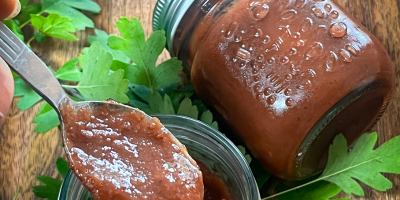
The berries – also known as haws – are ready when they’re deep red and come away easily from the branch. If you have to tug, they’re not quite there. If they squish in your fingers, they’ve gone too far. Pick mindfully, and always leave plenty for the birds. Hawthorn is one of their key winter foods. And do mind the thorns – they’re not shy! Once harvested, the berries can be dried for teas or decoctions, tinctured fresh, or turned into a variety of kitchen remedies. My favourite at this time of year is hawthorn ketchup. It’s earthy, warming because of the added spices, and a lovely way to bring the medicine into everyday meals. I only make a little jar, as it is quite labour intense and uses up a lot of the berries.
Spiced Hawthorn Ketchup
You’ll need:
– 500g hawthorn berries (washed and stalks removed)
– 300ml water
– 150ml apple cider vinegar
– 100g of local honey
– A pinch of sea salt
– Spices to taste: I like ground ginger, cinnamon, and a hint of clove. You can add cayenne if you want a little more fire.
To make, simmer the berries in the water for about 20 minutes until soft and bursting. Then press the mixture through a sieve to remove the seeds and skins. It’s a bit of work, but worth it. Return the pulp to the pan, stir in the vinegar, sugar, salt, and spices. Simmer again for 15 minutes until it thickens into a sauce. Taste and adjust as you go. Pour into sterilised jars or bottles. Store in the fridge and use within a couple of weeks. It freezes well too. We eat it with roasted roots, oatcakes, or spooned onto grain bowls with a little tangy cheese. It’s nothing like shop-bought ketchup – it’s richer, deeper, and somehow tastes of hedgerows and hearth.
The deeper lesson
There’s something about hawthorn that feels fiercely needed just now. She grows where the wind is strong, where the soil is poor, where others can’t thrive. She holds the line. She doesn’t flinch. And yet she gives us blossom, berry, shelter, medicine. In years when everything feels a bit off-kilter – too early, too much, too fast – I take comfort in her presence. Not because she fixes anything, but because she reminds me how to stand steady, how to protect what matters, and how to keep showing up with love, even when things feel a little wild. And maybe, just maybe, this is the deeper medicine we need right now – not just for our own hearts, but for the world’s.
Kristine x
If you’d like to learn with me and the plants through the seasons, the Crafty Herbalist Academy is open for autumn. We are about to begin our seasonal projects and it’s a beautiful time to join. Click here to learn more and sign up.
Kristine x
A NOTE ON SAFETY
Hawthorn is a gentle and well-loved herbal ally, but like all medicines, it should be used with care. It’s generally safe for long-term use, but if you are taking prescribed heart medications or have a diagnosed heart condition, please consult your healthcare provider or a qualified medical herbalist before using hawthorn regularly.
As always, this blog is for educational purposes only and isn’t a substitute for personalised medical advice.