I had used Albizia many times before I ever stood beneath one. I’d occasionally glimpsed the tree in London parks or while travelling through France, but for years I knew it mainly as a medicine in my dispensary, one I reach for when low mood lingers after grief, loss or heartache. I tend to use it as part of an individual formula, alongside other herbs chosen for the person in front of me, and have often been struck by how quickly it can begin to help.
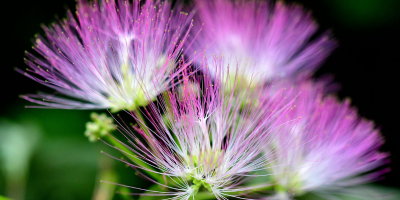
The tree itself remained rather hazy in my mind until this summer, when we stayed at Vila Dobra, a 500-year-old stone house in the Vipava Valley in Slovenia. Just outside the house, among the vines and fruit trees, was a wide, spreading tree with delicate, fern-like leaves and extraordinary pink flowers. Each flower was made up of long, silky stamens, pale at the base and deepening to pink at their tips, so that the whole canopy looked soft and feathery in the sunlight.
Albizia julibrissin is often called the Persian silk tree, silk tree or mimosa, although it isn’t a true member of the genus Mimosa. The family living at Vila Dobra knew and loved the tree but hadn’t realised it had a medicinal history. When I told them how I use it in clinic, we all stood underneath, looking up into the flowers.
I think that was when I fell for it completely. I already knew the medicine, but meeting the living tree gave me a much fuller sense of it.
Persian silk tree
Albizia julibrissin belongs to the pea family, Fabaceae, and is native to a broad region stretching from Iran through parts of China and into Korea and Japan. It has travelled widely as an ornamental tree, largely because of those beautiful flowers and its light, spreading canopy.
The leaves are bipinnate, meaning that they divide and divide again into many small leaflets. They close at night and may also fold in response to touch, heat or drought. This nightly folding has contributed to some of the stories surrounding the tree, with the paired leaflets settling together as darkness falls.
After flowering, Albizia produces flat, papery seed pods. In areas where conditions suit it particularly well, the tree has spread beyond gardens and is now considered invasive. That is less of an issue here in Britain, where it is grown mainly as an ornamental and usually needs a warm, sheltered position.
He huan – happiness together
In Chinese medicine, Albizia julibrissin is known as he huan. The name is often translated as ‘collective happiness’, ‘happiness together’ or ‘meeting in joy’.
Two parts are used medicinally:
- The flowers are known as he huan hua.
- The bark is known as he huan pi.
The flowers and bark have overlapping uses, although they aren’t regarded as entirely interchangeable. Traditionally, both have an affinity for emotional distress, sleeplessness, irritability and what Chinese medicine describes as constraint – the sense that emotion and energy have become stuck rather than moving through.
The bark has also been used traditionally following physical trauma, including bruising, pain and swelling. This may seem separate from its emotional use, but both involve something that has become obstructed and needs help to move again.
The association with happiness can make Albizia sound like a rather whimsical herb, as though it simply cheers people up. Its medicine is more particular than that. I don’t think of it as a general herbal antidepressant, nor as something to give indiscriminately whenever someone feels sad.
I find it especially useful when there is a recognisable story behind the low mood – bereavement, a painful separation, disappointment, loneliness or an old heartache that hasn’t quite loosened its grip. The immediate crisis may have passed, yet the sadness remains woven into sleep, energy and the ability to feel pleasure or interest in life.
Sometimes grief needs time, company and space rather than treatment. Herbal medicine shouldn’t turn an ordinary human response to loss into a disorder. But grief can also become exhausting, particularly when someone has other demands to meet and little opportunity to recover. This is where Albizia can be a valuable part of a formula.
How I use Albizia in clinic
I rarely prescribe Mimosa by itself. A person who is grieving may also be anxious, depleted, unable to sleep, physically tense, menopausal, overwhelmed or carrying a long history of stress. Another person may feel numb rather than tearful. Someone else may be irritable, restless and unable to stop thinking.
Those differences alter the whole prescription. I choose the rest of the formula according to the person’s constitution, health, medication, sleep, digestion, nervous system and the particular shape their distress has taken. Albizia then becomes one strand within a much more individual piece of medicine.
Within that context, I have found it particularly effective for lingering low mood, grief and heartache. It can work quite quickly, sometimes bringing a noticeable shift sooner than I would expect from a herb associated with such deep emotional states.
That doesn’t mean it erases grief. Nor would I want it to. Grief belongs to love and attachment, and there is no plant that can or should remove the meaning of what has been lost. What I look for is a little more movement – better sleep, less heaviness, a return of appetite or interest, and a greater ability to engage with life while the grief continues to find its place. That is subtler than promising happiness in a bottle, but it is also far more useful.
What does modern research tell us?
Research into Albizia julibrissin has identified a complex mixture of constituents, including triterpenoid saponins known as julibrosides, flavonoids, lignans, phenolic compounds, tannins and volatile constituents.
Modern studies have concentrated particularly on its possible antidepressant, anti-anxiety and sleep-supporting effects. Animal and laboratory research has reported changes in serotonin-related signalling, the stress-response system, inflammatory pathways and other mechanisms involved in mood and nervous-system function.
These findings are interesting because they offer plausible lines of enquiry alongside the plant’s long traditional use. They do not, however, amount to proof that Albizia is an effective treatment for depression in humans.
Most of the evidence remains preclinical, meaning that it comes from cells, isolated constituents or animal models. We don’t yet have the sort of large, well-designed human trials that would allow us to establish clinical effectiveness, standardised preparations or reliable dosing for particular diagnoses.
There is also a problem familiar to anyone who reads herbal research. A study using an isolated compound, concentrated fraction or particular laboratory extract cannot automatically be applied to a whole herb tincture, tea or powdered herb. The preparation and plant part influence what is extracted and how the medicine behaves.
For me, the research neither proves nor dismisses Albizia. It helps us understand possible mechanisms and confirms that this is a pharmacologically active plant worthy of further study. My use of it is informed by traditional knowledge, clinical experience and the needs of the individual, while remaining honest about the limits of the published evidence. My Academy students know only too well how I feel about this.
Folklore and the happiness tree
The name he huan has gathered a rich layer of symbolism around Albizia. The tree has become associated with reconciliation, companionship, marital harmony, relief after grief and the restoration of joy.
Its leaves folding together at night are sometimes compared with partners settling beside one another, which links the tree with rest, closeness and emotional comfort. Modern Western herbalists often call it the happiness tree, joy tree or forget-sorrow tree.
These names are lovely, but they can also make the medicine sound simpler than it is. Sorrow isn’t always something to forget. It may need to be spoken, witnessed and lived through.
The value of Albizia lies less in producing artificial happiness and more in helping where sorrow has become fixed and life has narrowed around it. That understanding feels closer to both its traditional use and what I have observed in clinic.
A note on safety
The medicinal use of Albizia shouldn’t be confused with casually eating parts of an ornamental tree.
The seeds and pods are not used in the same way as the medicinal flowers and bark. Poisoning has been documented in animals after they consumed substantial quantities, particularly of the pods. Reported effects include tremors, abnormal movements and convulsions. Pods and seeds should therefore be kept away from livestock, pets and children.
Safety information for medicinal preparations during pregnancy and breastfeeding is inadequate, so I would avoid its use without specialist guidance.
Reliable interaction data are also limited. Because Albizia may affect mood, sleep and the nervous system, anyone taking antidepressants, sedatives, sleeping medication or other psychiatric medicines should seek individual professional advice rather than combining them independently.
Persistent or severe depression, thoughts of self-harm, profound insomnia and sudden changes in mood need appropriate medical assessment. Albizia isn’t a substitute for urgent mental health care, prescribed treatment or the human support that grief and depression may require.
Correct identification is important. The common name ‘mimosa’ is applied to several unrelated plants, including true Mimosa species and some Acacia species. A common name alone is never enough when choosing medicinal material.
Properly meeting Mimosa
Before Slovenia, I knew the living tree mostly in passing, glimpsed through a car window in London or the French countryside. The medicine was far more familiar. It was the tincture I added when somebody described a bereavement that still sat heavily years later, or heartache that had quietly altered sleep, energy and enjoyment of life.
Now the medicine also has a physical presence in my mind: a broad canopy beside an old stone house, dozens of pink flowers above us and fine leaflets folding as the day came to an end.
Standing beneath the tree didn’t change how I use Albizia, but it deepened my relationship with it. I understood more clearly why a tree associated with happiness might also belong to grief.
Its medicine isn’t about forcing brightness into painful places. It is about helping life begin to move around the pain again. That is perhaps a more modest promise than the name ‘happiness tree’ might suggest, but in the right person, and within a formula that properly considers the whole picture, I’ve found it can be a deeply valuable herb.
Further reading
- Huang B, et al. Molecular basis and mechanism of action of Albizia julibrissin in depression and related disorders. Frontiers in Pharmacology. 2023.
- Yang Y, et al. Pharmacological spectrum of substances derived from Albizia julibrissin. International Journal of Molecular Sciences. 2025.
- Lu P, et al. A comparison review of Hehuan flowers and Hehuan bark. Journal of Ethnopharmacology. 2023.
- Knight A. Albizia julibrissin: Mimosa tree. Guide to Poisonous House and Garden Plants.
Want to learn herbal medicine in a grounded, practical way?
The Crafty Herbalist Academy is my online herbal medicine membership and foundation course, for people who want to learn herbs properly, at their own pace, with real guidance and support. It brings together tradition, science, folklore, remedy-making, seasonal practice and clinical herbal thinking, without rushing you or overwhelming you.
You can have a closer look at The Crafty Herbalist Academy here.
If the doors are closed at the moment, you can join the waiting list and I’ll let you know when the next intake opens.