Sweet woodruff – a memory in the linen cupboard
There are some plants you learn first from books, with their Latin names and tidy lists of actions. And then there are the ones that arrive long before that, part of ordinary life before you even know what they are.
Sweet woodruff was like that for me. My grandmother used to keep little pouches of dried herbs in her linen cupboard. I can still picture it now – clean sheets stacked neatly, proper wooden shelves, the cool hush of a cupboard door opening. And there, tucked between the linen, were these small fabric sachets that released the gentlest scent when you moved things around. Soft and warm, vanilla and almond-like, with something of new hay underneath. Comforting in a way I would not have been able to explain as a child. It was simply part of her house. Part of the linen and the order of things.
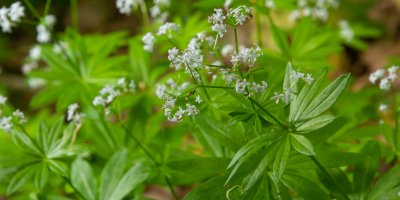
Only much later did I realise that scent had a name. Sweet woodruff (Galium odoratum). It is a modest little plant when you meet it growing. Low to the ground, fond of shade, with neat whorls of leaves around the stem and small white flowers in late spring. It does not look like something that would hold such a memory. In fact, when fresh, it can seem almost invisible. Pleasant, yes, but not something you would necessarily stop for.
Then you pick it and leave it a while, and that is when it begins. As sweet woodruff wilts and dries, its scent deepens. The warm, vanilla-almond fragrance comes from coumarins, the same family of compounds behind that familiar smell of newly cut grass and drying hay. It is not a bright, showy fragrance. It feels older, more domestic. More stored away in cupboards and summer rooms and linen folded for later.
Last summer, in Germany, I met it again in a completely different form. We were in a small village, the sort of place where you wander without much of a plan and somehow end up exactly where you need to be. There was a small bakery, and among the flavours of their homemade ice cream was sweet woodruff. Waldmeister.
Of course I had to try it. It was pale green, gently aromatic, and somehow both strange and familiar. A flavour that makes you pause halfway through and try to work out why you know it. And there it was again – my grandmother’s linen cupboard, years later, folded into a spoonful of ice cream in a German village. That is the thing about plant memories. They do not stay where you first found them.
Sweet woodruff has long been loved in parts of Europe, especially around May. In Germany it is used for Maibowle, the old May wine, where the herb is allowed to wilt first and then steeped briefly in wine. That wilting is the point. Too fresh, and you miss it.
Medicinally, sweet woodruff is a gentle plant. Traditionally it has been used as a mild calming herb, the sort you might think of where there is restlessness, tension, or sleep that does not quite settle. It also has old associations with lymphatic movement and the clearing of mild stagnation, particularly where the body feels a little heavy or slow after the richer foods and enclosed living of winter and early spring.
But it is still a coumarin-containing plant, so it calls for a light hand. Sweet woodruff belongs to occasional, seasonal use rather than strong daily doses. I would avoid internal use during pregnancy, with liver disease, or alongside anticoagulant medication unless guided by a qualified practitioner. Perhaps that is why it suits linen cupboards and May drinks and small domestic rituals so well. It belongs to the edges of things. The threshold between fresh and dried. Between scent and memory. Between spring’s green growth and the warmer days that follow.
To make a simple sweet woodruff cordial, pick a small handful of fresh flowering sweet woodruff and leave it to wilt for a few hours. Make a syrup with 500 ml water and 400 g sugar or honey, warming gently until everything is blended well. Take it off the heat and let it cool a little, then add the wilted sweet woodruff and the juice of half a lemon. Cover and leave to infuse for a few hours, or overnight if you want a stronger flavour. Strain, bottle, and keep in the fridge. Dilute with still or sparkling water, or add a little to gin or prosecco. The flavour is subtle – green, sweet, vanilla-almond-like, and quite otherworldly.
Sweet woodruff is not a plant that barges into the room. It waits in the cupboard and gathers strength as it wilts. It returns years later in a village ice cream, and suddenly you are back beside neatly folded linen, remembering something you did not know you had kept.
If this is the kind of seasonal, rooted herbal learning you’d like more of, you’re very welcome to have a look at The Crafty Herbalist Academy here.