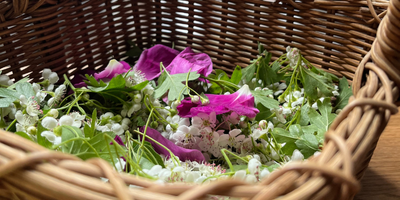
Returning to the May Tree and the Shape of Love
Every spring, when the hawthorn blooms and the hedgerows turn white, I feel it – that quiet pull back to something older than myself.
It’s not loud. It doesn’t demand anything. It’s just there – a soft ache, a tug at the edge of the chest. A remembering. A rhythm. A shape love takes, when you’re paying attention.
And before I know it, we’re walking the old path again – my daughter and I – toward the May Tree. The same footpath lined with cow parsley and nettles. The same slow anticipation. The same sense that we’re slipping back into something sacred.
We’ve done it since she was three. She still reaches for my hand. And in that simple act – one hand held, one reaching for blossom – my heart opens wide. It’s a ritual now, etched into the season, into motherhood, into love. The kind that lives in the small gestures. The kind you don’t even realise is becoming a tradition until it’s already taken root.
The tree has become a kind of seasonal waypoint in our year. We go with no big plan – just a sense that it’s time. We nibble leaves and petals. We breathe in the strange, heady scent that always catches me off guard. It’s floral, yes, but there’s something else beneath it. Something raw and animal and faintly unsettling – like the memory of something just out of reach.
We talk about bees and blossom and how different the world looks when you’re small. I watch her reach higher now, taller than she was last year, and feel that familiar mix of joy and ache that only parenthood can bring.
And every year, I’m reminded that herbal medicine doesn’t always begin with tinctures or textbooks. Sometimes it begins here – in a quiet hedgerow, under a flowering tree, with a child’s hand in yours.
Hawthorn (Crataegus monogyna and related species) is stitched deep into the folklore and landscape of these islands. She’s a hedgerow tree, yes – but she’s never been just that.
She’s the May Tree, named for the month she rules. In centuries past, her blossoms crowned the May Queen, wove through garlands, and hung above doorways to bless and protect. She was a symbol of life returning, of fertility and wildness and joy.
But she’s also a boundary-keeper. A protector. You’ll find her growing at field edges, ancient crossroads, wells, and earthworks – liminal places, where the veil thins. In folklore, she guards fairy hills and sacred ground. And her power wasn’t to be taken lightly.
Bringing hawthorn blossom indoors was long considered dangerous – said to bring illness, even death. Science offers an odd echo of the old wisdom: one of the compounds in hawthorn’s scent, trimethylamine, is also produced in the early stages of tissue breakdown. It gives the blossom a sweetness that’s not purely floral. There’s a shadow beneath it – musky, slightly fermented, like something soft beginning to fall away.
And so even in her beauty, hawthorn reminds us of endings. That love carries grief. That joy and loss live side by side. That what blooms must also fade. It’s not morbid. It’s honest. And that’s what I love about her.
Hawthorn holds opposites.
She is life and decay. Protection and softness. A tree of thorns, and a medicine for the heart.
In Western herbal energetics, she’s considered cooling and slightly drying – helpful for hearts that are hot, tight, overworked. The flowers and leaves, gathered in spring, are lighter and more aromatic. The berries, gathered in autumn, are denser, more tonic, more grounding.
Constitutionally, I often turn to hawthorn for people whose hearts are under pressure – physically or emotionally. The kind of person with flushed cheeks and a racing pulse, or chest tightness brought on by stress. The kind of person who’s trying to hold too much, for too long.
Hawthorn brings relief – but not by numbing. She supports. She holds. She creates space – both physiologically and emotionally – for the heart to do what it does best: open, close, rest, and open again.
She’s especially helpful at times of threshold – those moments when we’re asked to let go of one version of ourselves and step into another.
Heartbreak.
Grief.
Becoming a parent.
Losing a parent.
Menopause.
The end of something familiar.
The beginning of something unknown.
She doesn’t take the edge away, but she helps you meet it. One student once told me hawthorn was “the herb that helped me cry without feeling like I’d fall apart.” That’s it, really. She doesn’t stop the wave. She just helps you stay upright in it.
If you’re studying herbal medicine, here are a few notes for your practice:
- Parts used: flowering tops (leaf and flower) in spring; berries (haws) in autumn
- Therapeutic herbal actions: cardiotonic, hypotensive, antioxidant, anti-inflammatory, nervine
- Indications: mild to moderate hypertension, early-stage heart failure, palpitations, post-viral fatigue, anxiety with chest symptoms
- Contraindications: generally very safe, but consult a medical herbalist if on pharmaceutical heart medication
I use a fresh flower and leaf tincture in spring, and a berry decoction in the colder months. You can combine them, or work seasonally with each part in turn. Teas and syrups are lovely too.
One of my favourite ways to share hawthorn in spring is with a blossom cordial. It’s simple, sweet, and so easy to pass around. And it tastes like sunlight and hedgerows. My daughter loves to make it with me – stirred into sparkling water with raspberries or frozen in little ice cubes for summer.
Hawthorn Blossom Cordial
- 4 large handfuls of fresh hawthorn blossom
- 500ml water
- 300g local honey
- Half a lemon, sliced
- A few rose petals (optional)
To make:
- Prepare a simple syrup by gently heating the water with the honey until fully dissolved. Let it cool until warm – not boiling.
- Place the hawthorn blossoms (and rose petals, if using) and lemon slices in a clean bowl or jar.
- Pour the warm syrup over the blossoms and cover.
- Leave to infuse for 12 to 24 hours.
- Then strain through a muslin-lined sieve, bottle, and label.
- Store in the fridge and use within two weeks. It’s lovely in cool teas, cocktails, over fruit or porridge, or simply sipped from a glass with a little fizz. A small celebration of May.
I suppose what hawthorn teaches me, year after year, is that healing doesn’t have to be loud or dramatic to matter. Sometimes it’s just a return – to a tree, a walk, a moment you’ve lived before.
A gentle gathering.
A shared recipe.
A small hand reaching for yours.
A scent that says: you’ve been here before, and you’ll find your way again.
And that, I think, is herbalism at its truest. Not just a system of medicine – but a way of being in the world. A way of loving it more deeply.
We walk the old path again.
We gather.
We breathe.
We remember what love looks like.
Kristine x