Twelfth Night and Herbal Traditions:
As the festive season draws to a close and the quiet stillness of early January takes hold, Twelfth Night arrives – a moment rich in history, tradition, and meaning. Celebrated on 5th January, Twelfth Night marks the end of the Twelve Days of Christmas and the eve of Epiphany. But its roots and rituals go far beyond a simple date on the calendar.
For me, Twelfth Night holds a special place in my heart, tied to my childhood in Belgium. It was an evening of frosty air, starry skies, and simple joys. My siblings and I would dress up, sing door-to-door, and be welcomed by neighbours offering sweets or coins in return for our songs. Those small acts of connection felt magical – a celebration of community and the turning of the year.
Today, Twelfth Night remains a powerful marker of the season, blending ancient customs, folklore, and herbal traditions into a moment of reflection and renewal.
ORIGINS AND FOLKLORE OF TWELFTH NIGHT
The name “Twelfth Night” comes from the twelve days following Christmas, culminating in the feast of Epiphany on 6th January. In Christian tradition, Epiphany commemorates the arrival of the Magi, or Wise Men, bringing gifts to the infant Jesus. However, the roots of Twelfth Night stretch back even further, interweaving pagan midwinter festivals and Roman Saturnalia celebrations.
In medieval Europe, Twelfth Night was a time of inversion and revelry. Lords and servants swapped roles, and communities gathered for feasting, drinking, and merriment. Symbolic rituals like wassailing – the act of toasting orchards with spiced cider to bless the harvest – reflected humanity’s deep connection to nature and its cycles.
Twelfth Night customs also included clearing away the old to welcome the new. Decorations would be taken down, homes cleansed, and communities prepared for the year ahead. These rituals resonate deeply today, offering a chance to reset and step into the light of a new beginning.
TWELFTH NIGHT AND SHAKESPEARE’S HERBAL INSIGHTS
Shakespeare’s Twelfth Night captures the playful and transformative spirit of this time. It’s a story rich with themes of disguise, reversal, and human folly – much like the traditional festivities. But Shakespeare also weaves in the natural world with great care, drawing on the Elizabethan understanding of herbs and their humoral properties.
Take violets, for instance. In Act 1, Scene 1, Duke Orsino likens the fleeting nature of love to a “bank of violets.” In Elizabethan herbalism, violets were valued for their cooling and soothing qualities, used to calm fevers and melancholy. And they still are today! Shakespeare’s use of herbal symbolism reminds us that plants have long been seen as allies not just for the body but for the spirit as well.
HERBS AND RITUALS
Herbs play a central role in Twelfth Night traditions. Wassail, a warming blend of cider and spices like cinnamon and nutmeg, was both a festive drink and a symbolic act, bringing blessings to orchards and communities. Rosemary, a herb of remembrance and fidelity, was often included in feasts and decorations.
Even the tradition of baking a King’s Cake carried herbal significance. Spices like cardamom and cinnamon were used not just for flavour but as warming, uplifting ingredients – perfect for cold midwinter nights. A hidden bean or charm was placed inside the cake, crowning the finder as the “king” or “queen” of the celebration. This playful ritual reflected the spirit of hope and possibility that comes with the turning of the year.
RECIPE – CARDAMOM & LEMON BALM KING’S CAKE
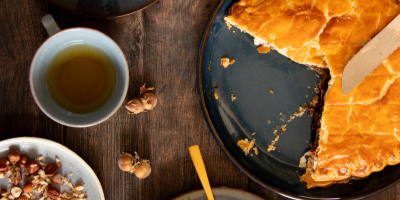
This year, I’ve reimagined the classic Flemish Driekoningentaart (Three King’s Cake) with a bit of a herbal twist. Lemon balm, cherished for its calming and uplifting properties, takes centre stage as an infused butter in this recipe. Its bright, citrusy aroma pairs beautifully with the warmth of cardamom, creating a cake that’s fragrant, comforting, and perfectly suited to winter celebrations.
Ingredients:
- 1 packet of puff pastry
- 125g almond flour
- 125g sugar
- 100g lemon balm-infused butter (instructions below)
- 2 eggs
- 1 tsp vanilla extract
- 1 tsp ground cardamom
- 1 tbsp finely chopped fresh lemon balm leaves (optional, for extra flavour)
- Optional: a small charm or dried bean
For the lemon balm-infused butter:
- 100g unsalted butter
- A handful of fresh lemon balm leaves, finely chopped (or 1 tbsp dried lemon balm)
Method for infusing butter:
- Gently melt the butter in a small saucepan over low heat.
- Add the lemon balm and simmer on the lowest heat for 20 minutes, stirring occasionally.
- Remove from heat and strain out the leaves using a fine sieve or cheesecloth. Allow the butter to cool slightly before using in the recipe.
Method for the cake:
- Preheat your oven to 200°C (400°F).
- Roll out the puff pastry and cut it into two large circles.
- In a mixing bowl, combine almond flour, sugar, lemon balm-infused butter, 1 egg, vanilla extract, cardamom, and optional chopped fresh lemon balm. Mix until smooth and creamy.
- Spread the almond mixture evenly onto one pastry circle, leaving a border around the edge.
- Lay the second pastry circle on top, sealing the edges by pressing down with a fork.
- Brush the top with the remaining egg for a golden finish.
- Bake for 25–30 minutes, or until golden brown and flaky.
- Let cool slightly before serving.
- Once the cake has cooled slightly, carefully make a small incision in the cake and insert the charm or bean into the filling.
- Slice and share – and discover who will be crowned the king or queen of the feast!