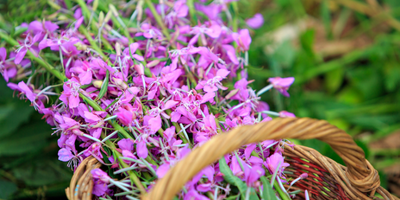
Fireweed’s Magic – Medicinal Flower Syrup
Yesterday was my daughter’s last day of school, and she came out carrying that peculiar mixture of excitement and sadness children often feel when something familiar has ended. We went walking among the rosebay willowherb afterwards, through great drifts of pink and purple flowers moving in the breeze. It is one of those plants that can completely change a landscape when it flowers, turning railway banks, woodland clearings and pieces of waste ground into something almost luminous.
Rosebay willowherb is also widely known as fireweed, particularly in North America, because it readily colonises land that has been burnt or disturbed. In Britain it became known as bombweed after spreading across bombsites during and after the Second World War. There is something deeply hopeful about the way it appears on damaged ground, although the plant itself is not delicate. It spreads vigorously through underground rhizomes, produces huge quantities of wind-borne seed and can establish large colonies where the soil has been opened up.
Identifying Rosebay willowherb
The currently accepted botanical name is Epilobium angustifolium, although you may also see it written as Chamaenerion angustifolium or Chamerion angustifolium in herbal books and research papers. It is a tall perennial, often growing well over a metre high, with upright reddish stems and narrow, willow-like leaves.
The flowers are pink to purplish, with four broad petals, and open gradually from the bottom of the flower spike upwards. Later in the season, the long seed capsules split open and release masses of fine, silky seed that drift away on the wind. One useful identification feature is the pattern of the leaf veins. Rather than running directly to the edge, the lateral veins curve around and join one another near the leaf margin.
Rosebay willowherb often grows in dense patches on woodland clearings, railway banks, roadsides, riverbanks, waste ground and places that have recently been cut, burnt or disturbed. It grows across much of the temperate Northern Hemisphere and is native to Britain. As always, be completely certain of your identification before gathering, and choose plants growing away from busy roads, sprayed land and contaminated ground.
Rosebay willowherb as food and medicine
Rosebay willowherb has a long history as both a food plant and a household remedy, particularly across northern and eastern Europe and among Indigenous communities in North America.
The young shoots have been eaten as a spring vegetable, while the leaves have been dried and fermented to make tea. Traditional medicinal uses have included digestive troubles, diarrhoea, stomach pain, sore throats, wounds, burns, inflamed skin and urinary complaints. Historical uses vary considerably between regions, but digestive problems and damaged or inflamed skin appear repeatedly in the record.
The leaves contain tannins, flavonoids and other polyphenols, including the ellagitannin oenothein B. Laboratory research has found antioxidant, anti-inflammatory and antimicrobial activity, and there is growing interest in the plant for skin preparations and wound care. Much of this research is still preclinical, however, so it is better understood as supporting some of the traditional uses rather than proving that rosebay willowherb treats particular health conditions in people.
From a traditional herbal perspective, its tannins give the plant an astringent quality, helping to tone and tighten tissue. This helps explain its older use where the digestive tract is loose, irritated or inflamed, and in washes or poultices for minor wounds and sore skin.
The flowers are milder and are often used more for food, colour and pleasure than as strong medicine. They make a particularly beautiful pink syrup.
Rosebay willowherb flower syrup
This syrup has a light floral flavour and a vivid colour. You can dilute it with still or sparkling water, stir it into lemonade, drizzle it over pancakes or ice cream, or add a small amount to a glass of Prosecco.
Ingredients:
- 4 cups freshly gathered rosebay willowherb flowers
- 4 cups water
- 2 cups sugar
- Juice of 1 lemon
Method:
Check the flowers carefully and remove insects, damaged blossoms and pieces of stem. Avoid washing them unless necessary, as this can remove some of the pollen and scent.
Place the water, sugar and lemon juice in a large saucepan and bring gently to the boil, stirring until the sugar has dissolved.
Remove the pan from the heat and allow the liquid to cool for a few minutes before adding the flowers.
Cover and leave the flowers to infuse overnight.
The following day, strain the liquid through a fine sieve lined with muslin, squeezing gently to collect as much of the syrup as possible.
Pour into clean, sterilised bottles or jars and label with the date.
Keep the syrup in the fridge and use it within a couple of weeks. For longer storage, freeze it in small containers or ice-cube trays. Discard it if you notice fermentation, mould, cloudiness or an unusual smell.
There are more clinically important herbs in the dispensary, but I do not think everything we make from plants has to carry a great medicinal purpose.
Sometimes a flower syrup is enough – something bright gathered with a child at the beginning of the summer holidays, bottled for cold drinks in the garden and remembered long after the last flowers have gone to seed.