ELECAMPANE – THE FORGOTTEN ROOT FOR GRIEF, BREATH, AND HEALING
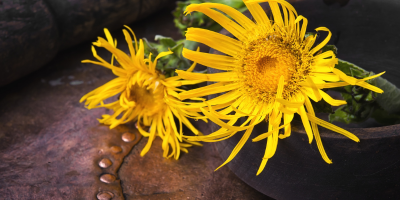
My elecampane is flowering. Tall and luminous at the back of the garden, with golden, tousled petals like miniature suns – not quite elegant, not quite wild, but something in between. I always think of it as a plant with presence. Not flashy, but sure of itself. Like someone who’s lived a long life and doesn’t need to prove anything anymore.
It’s the root I love most. Thick, knotted, a little bit stubborn in the soil. And when you break it – even just the smallest slice – there’s this scent that rises. Deep, resinous, spicy, slightly bitter. Like gingerbread left in a wooden chest. Or incense after the smoke has cleared.
That scent always takes me back to my grandmother. She kept a dark bottle in the cupboard, with a homemade syrup she gave us when we were ill. It was sticky, dark, and strong. I remember it coating the spoon, the odd taste – somewhere between comforting and slightly alarming – and how she’d say, “It’ll shift it.” And it did. For years I didn’t know what was in it. But much later, when I was making a tincture in clinic, I caught that same deep, spicy scent – and I knew. It was my grandmother’s elecampane.
FOLK REMEDY WITH ANCIENT ROOTS
Elecampane (Inula helenium) has been used in medicine for thousands of years. It appears in the works of Dioscorides and Pliny, who both praised its power for chest complaints. In medieval herbals, it was considered one of the most important herbs for phlegm and melancholy. And in English folk medicine, it was known as elfwort – a protector against fae mischief and “elf-shot” illnesses (what we might now call unexplained fatigue, sadness, or loss of vitality).
There’s a belief that Helen of Troy was holding elecampane when she was abducted – or that the plant grew where her tears fell, depending on which version of the myth you read. Either way, it’s long been a plant tied to sorrow, beauty, and the medicine that comes after heartbreak.
In my own Flemish roots, elecampane carries a thread of old protection magic. In one of my favourite books Flora Magica (1926), Isidoor Teirlinck lists Elecampane as one of nine powerful herbs used in folk bouquets to guard against storms and witchcraft. These were tied together on feast days like Pentecost and hung in homes as blessings. It was about keeping the home safe, grounded, and held. I love that. These old ways remind us that herbs were never just medicine. They were memory, story, and protection too.
In the Victorian era, elecampane was a popular ingredient in cough drops and lozenges. Herbalists often combined it with comfrey, marshmallow, or liquorice for chesty conditions. But even before that, it was common in farmhouse pantries – used in honeys, syrups, and herbal wines. This is a plant with deep roots in our kitchens as well as our gardens. In many parts of Europe, candied elecampane root was made into a sweetmeat. In other places, it was steeped in vinegar and taken as a tonic for digestion and winter immunity.
HERBAL ACTIONS
Elecampane is most famous for its effect on the lungs. It’s a warming, aromatic expectorant – which means it helps to move phlegm, especially when it’s thick, heavy, and stuck. It’s particularly helpful for damp, boggy conditions: chronic coughs, bronchitis, chest infections that linger. It doesn’t just soothe – it clears.
It contains a compound called alantolactone, which has been shown to be antimicrobial and antifungal, especially for the respiratory tract. It also contains inulin, a starchy prebiotic that feeds healthy gut flora. This makes it supportive for digestion as well, especially in cases of sluggishness, bloating, or dampness in the digestive tract.
In energetic terms, elecampane is warming and drying – perfect for cold, damp constitutions or conditions. I don’t tend to use it for someone who’s already dry or overheated unless I balance it carefully.
For chest complaints, I often pair it with thyme (warming and antimicrobial), marshmallow (soothing and moistening), or hyssop (especially if there’s emotional tension or tightness in the chest). In low doses, it supports digestion, lifts fatigue, and helps with emotional stagnation. In larger doses, it can be a bit too strong for some – causing nausea in very sensitive people. So I always start small and pay attention.
THE LUNGS AND THE HEART – ELECAMPANE AND GRIEF
The lungs are often where we hold grief. In Traditional Western Herbalism, and echoed in Chinese medicine, the lungs are the organ of sorrow – the place where we suppress tears, the breath we never let out, the sigh that never fully leaves the body. That’s why I reach for elecampane not just for the physical cough, but the emotional one.
For the person who can’t seem to take a full breath.
For the one who feels heavy in the chest.
For the grief that has become sticky – not acute anymore, but thick and unmoving.
I’ve given it to people in the months after a loss. Or to those caring for dying loved ones, who need to keep going but are quietly breaking inside. Elecampane doesn’t take the sadness away. But it seems to hold you while it moves through. It brings breath back to the body.
And sometimes, even just preparing the root – slicing it, steeping it, smelling it – is enough to shift something inside.
A ROOT THAT ASKS FOR PATIENCE
Elecampane isn’t a quick plant. It asks you to wait. To dig slowly. To work with the seasons.
You plant it in spring, and wait at least two years before harvesting the roots. You harvest in autumn, after the energy has sunk back down. And when you do, the roots can be hard work. You might need a fork, a knife, a bit of patience. But once it’s out of the soil, there’s this satisfaction – like retrieving something that’s been buried for a long time.
I often make a simple elecampane honey for winter. Just finely chopped root, layered in a jar with raw honey, and left to infuse for a few weeks. The result is spicy, aromatic, gently bitter. It’s lovely stirred into hot water when a cough is creeping in, or taken by the spoonful before bed.
Tincture is stronger – better for acute infections or deeper emotional work. I’ve also added it to steams, along with thyme and mint, for clearing the sinuses and lifting a heavy head.
REMEMBERING THROUGH PLANTS
For me, elecampane will always carry the thread of memory. It reminds me of my grandmother’s syrup, but also of her way of being – quiet strength, practical care, no fuss. She didn’t call herself a herbalist. But she knew what to do. She knew which cupboard held the remedies, and when something needed heat, or rest, or soup.
And that’s what I try to pass on in my own work – not just information, but remembrance. That these plants aren’t separate from us. They’re part of our stories. They grow alongside us. They wait for the right moment to be noticed.
Elecampane is not a fashionable herb. You won’t see it trending on social media. But it’s one of those steady allies that has walked with humans for centuries. In sickness, in sorrow, and in recovery. A plant for the deep places – not the surface symptoms, but the roots underneath. So when I see it blooming in my garden, I don’t just think of herbal actions or Latin names. I think of hands in the soil. Steam rising from the kitchen. The sound of a grandmother’s voice. And all the ways we come back to ourselves…
Kristine x
A NOTE ON SAFETY
Elecampane is a powerful root, and a little goes a long way. It’s best used in low doses, and not everyone will tolerate it well. If you have a known allergy to plants in the daisy family (Asteraceae), it’s wise to approach with caution, as elecampane may cause allergic reactions. The root contains compounds called sesquiterpene lactones, which can be irritating to sensitive skin and mucous membranes. In some people, it may cause contact dermatitis. In large amounts, elecampane can lead to digestive upset, think cramping, diarrhoea, or even nausea and vomiting. So always start small, and if in doubt, work with a qualified practitioner. Herbs are strong allies, but like any relationship, it’s about knowing how to meet them with care.