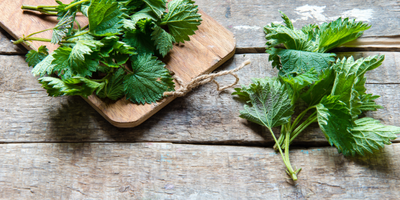
Before the Nettles turn, on the edge of Spring
I stood in front of a patch of nettles this week and found myself hesitating.
Scissors in hand, basket by my side… but something in me paused. The plants were taller now. The sting sharper. A few of the females had started to flower – their lush strands just beginning to droop. The bright softness of early spring had shifted into something fuller, stronger. The light felt different. The air carried more weight. The green had deepened.
And I felt it – the season turning. Not all at once, but enough to catch me. Nettle was changing. And as always at the turning points, something in me was changing too.
I’ve had a long relationship with this plant. Nettle was one of the first to really speak to me. I don’t mean in a whimsical way. I mean she got under my skin – quite literally, more than once – and stayed there. She was there in my early foraging days, when I thought I already knew what I needed to know. She was there after both of my children were born, when I was tired to my bones. She’s been there in times of emotional depletion, and in those deep, foggy spaces when life feels like it’s standing still.
She’s not a gentle hug, like chamomile. She’s not comforting in a soft, scented way like lavender. But she’s clear. Direct. Fiercely generous. And utterly reliable. I respect her so deeply.
My teacher, Christopher Hedley, had a way of telling stories about nettle that made you feel like you were meeting her for the first time. He spoke about her upright nature. Her sting. Her honesty. I remember him recommending nettle to a woman who was feeling completely stuck – heavy and directionless, caught in the static pull of a life that didn’t feel like her own. She was living in London, feeling lost. He reminded her that London is built on a swamp – and that stagnation can seep into the bones.
Nettle, he said, was a plant that gets things moving. Not just in the body, but in the spirit. She wakes us up. Brings blood to the surface. Helps us remember our own edges. That woman left the city not long after. She started again. She came back to herself.
I miss Christopher. His stories. His hugs. The way he made space for all of us to find our own relationship with the plants – not through rules, but through lived experience. Through trust. And a sprinkling of fairy dust… he really was one of a kind.
I think that’s what nettle teaches, too. You can’t learn her from a list of constituents. You have to meet her. Walk with her. Feel her sting. Taste her medicine. And notice what changes in you over time.
Why herbalists love Nettle so much
There are few plants as well-loved in the herbal world as nettle. She’s not dramatic. Not fashionable. But she’s strong, dependable, and full of potential.
Nettle is rich in minerals, iron, calcium, magnesium, silica and more, and deeply nourishing for people who are rebuilding after long periods of stress, illness, or depletion. I often think of her as the herb for those who are frayed around the edges. The ones still trying to get their feet back under them.
Energetically, nettle is drying and cooling. She clears heat and stagnation. She strengthens tissue, builds blood, improves resilience. Some sources list her as heating, but in practice I’ve found her cooling and stabilising, especially for those who are hot, inflamed, or burnt out. She’s especially helpful for people with seasonal allergies or histamine issues – her sting contains histamine and acetylcholine, which, paradoxically, help regulate reactivity. Fresh, she’s stimulating and vibrant. Dried, she becomes a little more toning. In this cordial recipe below, you’ll be working with fresh spring tops – before she shifts into seed.
Vibrant Nettle Cordial
Ingredients:
- A generous double handful of fresh young nettle tops (use gloves!)
- 500 ml water
- Juice and zest of 1 unwaxed lemon
- 150–200 g local runny honey (adjust to taste)
- Optional: a sprig of fresh mint, a few slices of ginger, or a little lemon balm
Method:
- First, make your honey syrup: warm the water, lemon juice, and zest in a pan. Stir in the honey until fully dissolved.
- Place your fresh nettle tops (and any optional extras) into a clean glass jar.
- Pour the warm honey syrup over the nettles, making sure they’re fully covered.
- Cover with a lid and let it infuse overnight at room temperature.
- The next day, strain through a muslin-lined sieve.
- Bottle and store in the fridge. Use within three weeks.
How to use:
- Add a splash to cool still or sparkling water
- Stir into herbal tea
- Drizzle over porridge or yoghurt
- Freeze in ice cube trays for later use
A note on harvesting
Use only young, healthy nettle tops, and avoid areas near busy roads, polluted ground, or where dogs roam. Once the plant begins flowering and seeding, her chemistry changes – she’s best avoided in large amounts after that point.
What this time of year teaches me
This edge of spring – late May, almost summer – is all about momentum. Everything’s growing fast. The birds are loud. The sting is sharper. And the plants, like us, are shifting from softness into fullness. Nettle is changing. And she asks us to pay attention.
I hope this little recipe gives you a way to work with her while the timing is just right.
And maybe – if you let yourself pause for a moment – you’ll feel it too.
Yes, the sting. But also, the movement, and the strength.
Kristine x