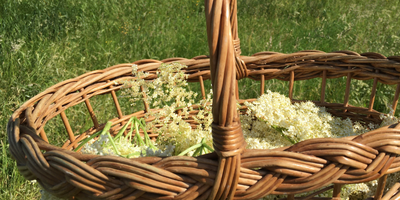
Baskets full of Elderflowers, and the stories they carry
The elder tree is flowering again.
Tucked into hedgerows, half-lurking near footpaths and forgotten boundaries, her creamy blossoms are just beginning to open. There’s a peculiar magic to the scent of elderflower. Sweet, but not sugary. Floral, but not perfume-like. It’s a heady kind of sweetness – something like muscat grapes, honey, and a touch of spiced citrus all muddled together. It fills the air, and if you catch it at just the right moment, it almost sparkles. When it’s fresh, it smells of midsummer and old kitchens. When it goes over – and you’ll know – it turns sharp and acrid, with a sour tang that reminds some people (not wrongly) of cat pee.
To most passers-by, she’s little more than a scruffy tree. But those who work with herbs, or who grew up hearing old tales, know she is not to be taken lightly.
MY ROOTS WITH ELDER
I can’t remember a time when elder wasn’t part of my life.
Both my mother and grandmother had elder trees in their gardens. They weren’t planted deliberately, they just arrived and were never moved. I was taught early on that you never cut an elder without asking. My grandmother, who never called herself a herbalist but knew more than most, would nod toward the tree and say, “She watches.”
We made elderflower tea for fevers, soaked cloths in cooled infusions for sore eyes, and later, brewed syrup for coughs that lingered through winter. Elder was just there. Familiar. Trusted. A silent figure at the edge of childhood summers.
Now I take my own children foraging when the elderflowers bloom. We go with baskets and stories, and I teach them as I was taught: never strip a tree. Never take too much. Leave some for the bees, the birds, and the berries to come.
It upsets me deeply when I see elder trees stripped bare. It happens more now – perhaps because the cordial has become popular again, or because people see it as ‘free food.’ But elder is not just free for the taking. She gives generously, but she remembers. These old trees hold memory in their bark. Reciprocity matters.
My children have grown to love her too. They know her scent. They know which trees near us bloom earliest. And every year, without fail, they ask, “Can we make fritters?”
Elderflower fritters – dipped in a light batter and fried until golden – are a seasonal delight in our house. They feel like celebration food. The kind of recipe that calls for slow afternoons and sticky fingers. It’s these tiny rituals that I hope they’ll carry into adulthood. Not just the making, but the remembering.
THE TREE THAT WATCHES
Elder (Sambucus nigra) is a plant of boundaries and margins. She grows where things meet – road and field, farm and forest, the known and the unknown. This, in herbal and folkloric tradition, marks her as a threshold plant. A tree that doesn’t just sit within the world, but between worlds.
In many parts of Europe, she was believed to house a spirit: the Elder Mother – Hylde Moer. Protective, powerful, and particular. One did not cut elder wood or harvest her flowers without first asking permission. The ritual varied by region, but the essence was the same: you bowed your head, you whispered a request, and you waited. Not for an answer, necessarily, but for an alignment of intent. A moment of acknowledgement. It wasn’t superstition. It was etiquette.
There are stories of those who didn’t ask. Milk spoiled. Bees swarmed. Bread wouldn’t rise. In Devon, they said never to burn elder wood indoors – the Elder Mother would take offence and fill your house with smoke. In parts of Lincolnshire, a green elder branch was placed in the crib to protect newborns. In some places, it was forbidden to use elder wood for furniture, lest the tree’s spirit continue to haunt the home long after the chair was carved. And all across the British Isles, elder was planted at the edge of properties not for beauty, but for boundary. She kept the bad out, and the good in.
In some versions of English folklore, witches were said to gather under elder at night, using her hollow branches as wands. In others, elder groves were portals – places where time passed differently, where dreams bled into waking. The association with the fairy realm runs deep, and not always sweetly.
BIRTH AND DEATH, SICKNESS AND SWEETNESS
In herbal medicine, elder is one of those rare plants that walks with us through all of life’s stages. Elderflowers are gentle, cooling diaphoretics. They help the body sweat gently when feverish, particularly in children or the frail. They’re soft enough to use in eye washes, yet potent enough to shift a brewing summer cold. In some old household manuals, elderflower water was also used to soothe sunburn and soften the skin. They were right, it does work!
The berries come later in the year, and they bring with them a different kind of strength. They’re rich in anthocyanins and antiviral compounds, and they’ve been used for centuries to support the immune system. Modern studies echo the old wisdom: elderberries may shorten the duration of colds and flus. I’ve always found them most powerful when cooked slowly with ginger, cinnamon, cloves, and a bit of apple.
Even the bark and leaves had their place in traditional medicine, though with more caution. They were used as purgatives or poultices – useful in the hands of those who knew what they were doing, dangerous otherwise.
But elder is never just medicine. She is story and symbol too. Midwives once wore elderflower tucked into their belts as a charm for safe passage. Funeral wreaths were woven from her branches in some rural areas, and elderflower wine was served at wakes in others. To drink elder in any form was to acknowledge both life and death – and the sacred dance between them.
She appears in old fairytales as both protector and punisher – a tree you turned to in need, but never took from lightly. That tension – of care and caution – is what gives elder her power. She teaches discernment. She reminds us that not all medicine comes easy.
CROSSING THE THRESHOLD
There is a moment, when you see the first elderflowers bloom, that something shifts in the air. It might still feel like spring, but the hedgerow knows: summer is arriving. The light has changed. The green deepens. We’re crossing over.
That’s why I always stop. Always breathe her in. Always whisper a thank you, even if just under my breath.
This week, I gathered a few flower heads. I took my time. There is something ceremonial about it, even if you don’t mean it to be. You move slower. You notice more. A bird nearby. A nettle sting. That slight ache behind your eyes that means you need more rest. You gather only what you need, and you remember how lucky you are to live near wildness.
There is a very particular feeling to making elderflower cordial. It’s not just practical and fun – it’s anchoring. It’s a way of saying: I live here. I’m part of this. I honour this moment in the turning year. I’ve been making elderflower cordial for years now, and it’s never quite the same batch twice. Some years I add more lemon, other times I steep it longer. It always tastes like that brief in-between moment: not quite spring, not quite summer. Just here. Just now.
ELDERFLOWER CORDIAL RECIPE
You’ll need:
- Around 20 freshly picked elderflower heads (gather on a dry, sunny day, ideally late morning when the scent is strongest – don’t strip entire trees, walk a long way)
- 1 organic unwaxed lemon, sliced
- 1 litre of water
- 500g honey or sugar (I like the taste of honey, or you can use date sugar or unrefined cane sugar)
- 25g citric acid (optional, for preservation)
Method:
- Gently shake the flower heads to remove insects. Don’t rinse – the pollen is where the scent lives.
- Place the flowers and lemon slices in a large non-reactive bowl or pot.
- In a separate pan, bring the water to a boil. If using sugar, stir it in and dissolve fully.
- If using honey, remove the pan from heat first, then stir in the honey and citric acid (if using). Leave to gentle simmer for a few minutes, but don’t boil. This protects the therapeutic qualities of the honey.
- Pour the warm syrup over the elderflowers and lemons. Cover with a clean cloth.
- Leave to infuse at room temperature for 24 hours.
- Strain through muslin or a fine sieve into sterilised glass bottles.
- Store in the fridge and use within 3 weeks, or freeze in small batches.
Optional:
- Add a few rose petals or meadowsweet flowers for a floral complexity.
- A strip of orange peel instead of lemon for a richer flavour.
- A dash of apple cider vinegar if you prefer something with a slight tang.
If elder is flowering near you this week, go and visit her. Not to take, necessarily. Just to acknowledge. Let the scent find you. Let the season tip you forward. Ask permission. Listen for the reply. And if you do make the cordial – or the fritters – I’d love to hear how yours turn out.
Kristine x