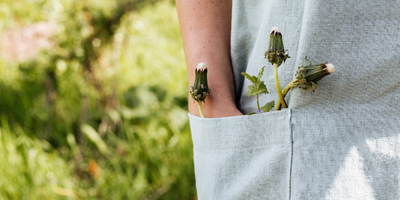
Dandelions in Jumpers and Pockets full of Earth Medicine
The dandelions were bright that day – like little suns scattered across the green. I hadn’t brought a basket, of course. Just a walk, a pocketless jumper, and two muddy-kneed children racing ahead. So I did what I’ve done many times before: gathered the dandelions into the front of my jumper and hoped they wouldn’t fall out before we made it home.
My daughter watched me and asked, “Why didn’t you wear one of your pocket dresses?”
Good question.
Later, as I brushed petals off the kitchen counter, I found myself thinking not just about pockets – but about how we carry the things that matter. The way pockets give us space to gather, to hold, to be self-reliant. The way they make us a little more prepared. A little more rooted. Especially for those of us who live close to the land, make things by hand, and carry centuries of women’s knowledge stitched quietly into the everyday.
My grandmother was a skilled seamstress. She could turn old sheets into aprons and fix a hem with her eyes closed. I remember the sound of her sewing machine – a proper old Singer one – and the careful rhythm of her stitches. Her sewing room always smelt faintly of lavender and machine oil. It was tucked into the back of the house, sunny and peaceful, with jars of buttons, spools of thread, pins in soft strawberry cushions. I used to sit on the floor playing with scraps of fabric while she worked, fascinated by how something plain could become useful and beautiful with a bit of time and care. I think that was the first place I learnt the value of making do, of crafting what you need with what you’ve got. Pockets included.
And that room taught me something else too – how quiet, simple things can hold deep meaning. A pocket isn’t just a bit of cloth. It’s a space we carve out in a world that often wants us small. It’s a place for readiness, for memory, for dignity.
Hidden History in the Fabric
Between the 17th and 19th centuries, women’s clothing almost always included tie-on pockets – separate, generous cloth pouches worn underneath the skirts and tied around the waist. You accessed them through hidden slits in the outer layers. They were often beautifully made but entirely practical – plain cotton, sturdy linen, sometimes even quilted for extra durability. Women embroidered initials on them. They were stitched with pride. Handed down. Made to last.
They were hidden from view, but carried a woman’s world inside them.
And they carried more than physical objects. Pockets carried independence. Resourcefulness. Evidence of daily life. A small, practical rebellion in the folds of fabric.
These pockets weren’t delicate. They were made for use. Patched and mended again and again. Passed between mothers and daughters. Worn daily. And inside them?
- Coins, keys, and needles
- Foraged herbs and scraps of fabric
- A love letter. A dried flower. A bite of bread
- A bit of beeswax, a folded recipe, maybe a comb or a thimble
Pockets weren’t frills. They were freedom. Portable little spaces for autonomy, tucked away beneath layers. The only private place a woman might have in her day.
And then, slowly, they began to disappear.
The Quiet Disappearance
By the early 1800s, dress shapes changed. Waists rose, fabrics thinned, and the silhouette became everything. Tie-on pockets were deemed bulky. Unladylike. Inappropriate. They spoiled the lines of fashionable garments.
In their place came the reticule – a dainty drawstring handbag that couldn’t carry much more than a lace-trimmed handkerchief. Reticule. Ridiculous. It was style over substance. A handbag for display, not for utility. And it marked a turning point. As clothing became more ornamental, women’s roles were increasingly confined to the home. Practical garments were out. Practical skills were on the decline too.
Around the same time, women were being pushed further from independence – from herbal medicine, midwifery, community-based healing, land work. The message was subtle but strong: look pretty, stay home, don’t carry too much.
And so the pocket – a symbol of doing, of agency, of usefulness – quietly vanished from women’s wardrobes. But not, thankfully, from memory.
Why This Matters to Herbalists
If you’ve ever gone out to gather nettles, tuck some hawthorn blossom into your pocket, or slipped a scrap of cloth in your apron for straining a tincture later… you’ll know exactly why pockets matter.
They’re not just fabric. They’re function. And they’re part of a lineage.
A real pocket is permission. It says: you are allowed to carry your own tools. Your own stories. Your own knowledge. You don’t need a handbag, or a helper, or a neat container. You’ve got what you need, right here, stitched in.
And I think that matters. Because herbalism is not a clean, curated affair. It’s muddy boots and stains on your dress and that one useful bit of twine you keep in your pocket “just in case.” It’s readiness. Resourcefulness. It’s walking the land with your hands free and your mind open.
Practical Reclaiming
I like things that work. I like clothes that hold things. That’s why nearly every dress I buy has pockets. And when they don’t? I sew one in or wear a tie-on pocket over the top.
You can make one yourself. Just a bit of linen, a hem, and two ties for your waist. Or upcycle an old pillowcase or tea towel if you’re feeling scrappy (and I often am). You can hand-stitch it in an evening. Let the shape be imperfect – it’s still worthy. Let it hold something ordinary – a tissue, a penknife, a little jar of plantain balm.
And then try walking the land with it. Go out into the garden or woods and see what happens. It’s amazing how different it feels to be hands-free and ready.
What would you tuck in yours?
- A pair of secateurs
- A muslin cloth
- Tissues (always)
- A crumpled note or recipe
- A piece of root you picked up and forgot to label
- A conker, a snail shell, a feather from your last walk
- Your keys, your phone, and your courage
The point is, it’s yours. A mobile little piece of sovereignty.
Carrying Across Cultures
This isn’t just a British or European thing.
In Japan, work aprons called maekake carried seeds and tools. In West Africa, cloth folds tucked around the body held herbs, charms, food. In many Indigenous cultures, medicine bags hung around the neck or waist, filled with sacred items – plants, feathers, stories.
Different shapes. Different stitches. But the same truth: the right to carry is the right to remember. These weren’t just practical items. They were ceremonial. Personal. Embedded in identity and belonging.
Still Relevant Today
The world still wants women to be tidy. Minimal. Tucked away. There’s a strange pride sometimes in saying, “Oh, I don’t carry anything.” But I don’t think that’s the whole story.
I think it’s powerful to say: “I carry what I need.”
Whether that’s herbal tools, or snacks for your children, or a notebook with half-formed thoughts, it counts.
Those of us who walk the old paths – who carry remedies in our pockets, wildflowers in our jumpers, and seeds in our coat linings – we’re not here for show.
We’re here to gather. To make. To teach. To carry what matters.
So yes, I’ll keep being the woman with dandelions in her jumper.
And maybe you will too.
Further Reading
- The Pocket: A Hidden History of Women’s Lives – Barbara Burman & Ariane Fennetaux
- The History of Pockets – V&A Museum
- What Clothes Reveal – Linda Baumgarten
- The Secret Life of Pockets – BBC History Extra podcast