The spring stories we were never told – of hares and bells
With the arrival of spring, the colour yellow seems to be everywhere. The other day I went for a walk with my boy along the green lanes of our town – fresh air, sunny, his freckled nose pink with the cold. And amongst the sea of yellow flowers, he knew exactly which was which.
He knew dandelion flowers can be eaten – as fritters, to be more exact, and gosh he loves them. He knew lesser celandine is not eaten raw; it can make you pretty sick. And he knew that coltsfoot flowers look a little like dandelions, but the leaves appear after it flowers. He has been taking this information in like a sponge since he was tiny.
I felt such pride in that moment. But it was more than pride, really. It was something older than that – a sense of belonging, of lineage, of things being passed on. I learned my first plants from my grandmother. Later, from Christopher Hedley, one of the great British herbalists of his generation. And here was my seven year old, on a lane in the early spring sunshine, knowing his celandine from his coltsfoot.
As the season turns, I often find myself reaching for the old stories – the ones that sit just beneath the surface of our modern celebrations. And Easter, more than most, is stitched through with layers of meaning we don’t often talk about.
The other side of Easter – what came before the bunny?
In the British Isles, this time of year once belonged to Ēostre (sometimes called Ostara), a spring goddess associated with dawn, renewal, and fertility. Though historical records are scarce, she lives on in folklore and seasonal tradition – and she may well be the root of the word “Easter” itself.
One tale tells of Ēostre finding a wounded bird at the edge of winter. To save its life, she transformed it into a hare – a creature able to survive the still-cold nights and leap with strength into spring. But the bird, even in its new form, retained the ability to lay eggs. Grateful, it laid brightly coloured ones as an offering to the goddess. A strange little tale, perhaps, but it echoes something many of us sense around this time of year: the mix of fragility and renewal, of old forms giving way to new.
The Hare and the Moon
Unlike the soft bunny of modern Easter cards, the hare has long been a creature of the wild. Elusive, strong, and strange in its behaviour, it was revered in many ancient cultures. Hares are closely linked to the moon. In Celtic tradition, they were believed to carry messages between the human world and the Otherworld. In spring, when hares are often seen boxing in the fields, they seem almost enchanted – liminal beings dancing at the edge of our world.
And then there’s the moon itself. The full moon closest to the spring equinox – often called the Pink Moon – was carefully watched by those who lived with the rhythms of the earth. It marked a turning point, a threshold, a time of emergence.
For those who follow the Wheel of the Year, this moon and this season are not just about eggs and hot cross buns. They are about the returning of life after the long stillness of winter. About planting seeds – literal and symbolic – and trusting in what may come.
The Easter Bells of Belgium
Back in Belgium, where I grew up, we didn’t have the Easter Bunny as such. We had something altogether more mysterious (and rather odd, now I think about it!): the Easter Bells.
According to tradition, all the church bells in the country flew off to Rome on Maundy Thursday, carrying the grief of the crucifixion with them. Their absence left towns in eerie silence. And then, on Easter Sunday, they returned – ringing joyfully and “dropping” eggs into gardens for children to find.
As a child, I was completely enchanted by this story. I remember waking early with my siblings, baskets in hand, believing that those great bronze bells had flown over the rooftops in the night, scattering chocolate and magic as they passed.
I think about that now – the blend of silence, waiting, and return. How Easter, in both its Christian and pre-Christian forms, is always about a kind of resurrection. A waiting in the dark, followed by a re-emergence into light and colour.
Eggs as a symbol of life
Long before eggs became a seasonal sweet treat, they were powerful symbols of fertility, potential, and the mystery of life tucked inside a simple shell.
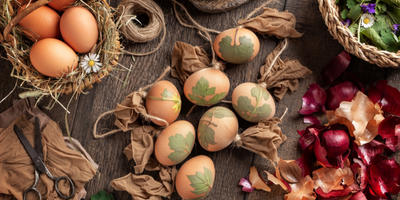
In many folk traditions, eggs were dyed red to honour the life force – blood, vitality, and the spark of creation. Others wrapped them in onion skins and pressed them with herbs, transferring the delicate patterns of plants onto the shell through a gentle, natural dyeing process.
Eggs were blessings. Tokens of gratitude and hope, crafted with care and offered to the land, to each other, and to the season itself. As a herbalist, I see something of this sacredness in seeds, in unfurling leaves and in remedies made by hand. Nature has always carried its own stories – and spring, most of all, seems to whisper: begin again.
Finding the threads of meaning today
These days, it’s easy to overlook all of this. Easter arrives in a flurry of sales and sugar, and the deeper rhythms can get lost. But if we pause – just for a moment – the old stories are still there. They live in the hares we glimpse at dusk, in the bulbs pushing up through last year’s leaves, in the birds rebuilding their nests with quiet determination.
And they live in us too.
Many of us feel a kind of inner stirring around this time of year. A desire to clear out, to plant something, to reconnect with the outside world. That’s not just spring fever – it’s something much older. Something our ancestors recognised, long before calendars and clocks.
Seasonal ways to celebrate (that don’t involve plastic grass!)
If you’d like to reconnect with the deeper roots of this season, here are a few simple things you might try:
- Make herbal-dyed eggs using onion skins, beetroot, or nettles. Wrap them with fresh leaves to create beautiful patterns before boiling.
- Leave an offering of oats, herbs, or seeds for the wild creatures, especially hares, if you’re lucky enough to spot one nearby.
- Take a full moon walk, even just around your garden or block. Feel the light on your face. Listen.
- Brew a spring tonic tea – perhaps nettle, cleavers, or dandelion – and drink it slowly, as an act of welcome.
- Tell a story. To a child, a friend, or just yourself. Share the tale of the Easter Bells, or the hare who laid an egg. Pass it on. My little ones love this!
What stays with me most at this time of year is not the chocolate eggs or the polished version of Easter, but the older threads still running underneath it all. A child knowing dandelion from coltsfoot. The odd old story about bells flying to Rome. A hare glimpsed in a field and feeling, somehow, like more than just an animal. These things may seem small, but they are important. They are part of how knowledge survives.
And that is more valuable than we realise. Not just because the stories are beautiful, though they are. But because they keep us paying attention. To the season. To the plants. To the land beneath our feet. To what is worth passing on.
If you’d like to join us this season to deepen your herbal learning and connection to nature, do have a look at what the Academy can offer you here.